
Most people know exactly what procrastination feels like. You have something important to do, and even though you intend to do it, you somehow find yourself checking email, scrolling social media, cleaning your desk, or doing almost anything except the task you meant to start.
If you’ve ever found yourself asking, “why do I procrastinate so much?”, you’re not alone.
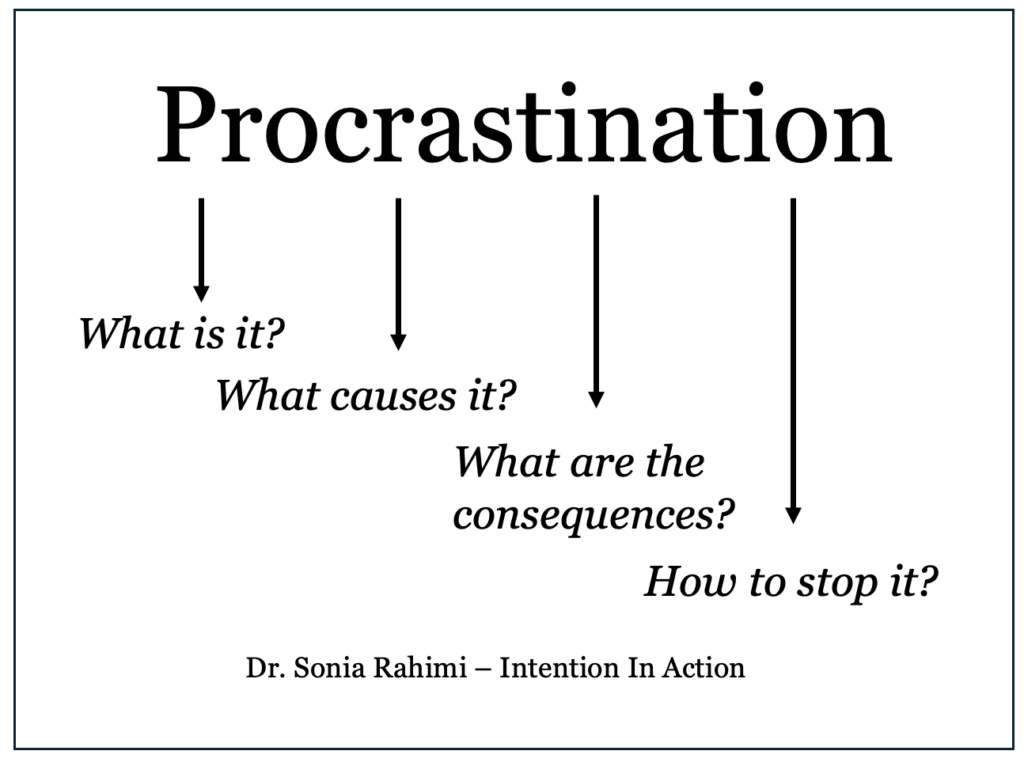
Research shows that procrastination is not a character flaw. It is one of the most common self-regulation challenges people face, affecting students, professionals, entrepreneurs, and highly motivated individuals. After years studying procrastination research, I’ve found that much of what we know about procrastination can be organized around four fundamental questions:
1. What Is Procrastination? (Definition and Meaning)
The first question seems simple, but it’s surprisingly important.
Many people use the word procrastination to describe any kind of delay. However, researchers make an important distinction: sometimes delaying a task is rational and beneficial. Procrastination occurs when we voluntarily postpone an intended course of action despite expecting that the delay will make things worse (Steel, 2007).
To understand this fully, we look at:
- What exactly counts as procrastination?
- What is the history of procrastination?
- How is procrastination different from simply delaying a task?
- How common is procrastination?
- Are there different types of procrastination?
- Does procrastination look different at school, at work, and in everyday life?
- How do researchers study and measure procrastination?
Understanding what procrastination is naturally leads to a more important question: why does it happen in the first place?
2. Why Do People Procrastinate? (The Real Causes)
This is the question most people care about.
Procrastination is not simply a problem of laziness or poor time management. Research suggests that procrastination is influenced by a complex mix of emotions, thoughts, personality traits, and characteristics of the task itself.
Sometimes we procrastinate because a task feels overwhelming. Sometimes it’s because we’re anxious about how we’ll perform. Other times, we’re avoiding boredom, uncertainty, frustration, or the possibility of failure.
The more researchers have studied procrastination, the clearer it has become that there is no single cause. Different people procrastinate for different reasons.
To understand this fully, we look at:
- Why do I procrastinate even when I know the task is important?
- Why does anxiety make it harder to get started?
- Why do perfectionists often procrastinate?
- Why are boring tasks so difficult to begin?
- How does uncertainty lead to delay?
- What role do motivation and self-control actually play?
Once we understand why procrastination happens, the next question is what impact it actually has on our lives.
3. What Are The Consequences of Procrastination?
Many people think of procrastination as a minor inconvenience or a habit that occasionally creates stress. When procrastination becomes chronic, research has linked it to increased stress, lower well-being, poorer performance, and difficulty achieving important goals. The effects can show up in school, at work, in finances, in health behaviours, and even in our relationships.
To understand this fully, we look at:
- How does procrastination affect mental health and well-being?
- What is the relationship between procrastination and stress?
- How does procrastination affect academic performance?
- What are the costs of procrastination in the workplace?
- Can procrastination contribute to burnout?
- What are the long-term effects of chronic procrastination?
Finally, we can turn to the question most people ultimately want answered: what can we do about it?
4. How to Stop Procrastinating: Research-Backed Strategies
Researchers have identified a variety of strategies that can help people reduce unnecessary delay and follow through on their intentions. The key is understanding why procrastination is happening and applying approaches that address the underlying causes.
To understand this fully, we look at:
- How can I stop procrastinating when I don’t feel motivated?
- What’s the best way to get started on a task I keep avoiding?
- How can I overcome anxiety-driven procrastination?
- Which anti-procrastination strategies are supported by research?
- How do habits influence procrastination?
- How can individuals, teams, and organizations reduce procrastination?
The Big Picture
Procrastination is often treated as a simple problem with a simple solution: just do the task. However, decades of research suggest that the reality is more nuanced.
To understand procrastination, we need to understand what it is, why it happens, how it affects our lives, and what can be done about it. This guide is designed to help you explore each of those questions and discover what the science of procrastination reveals about how we avoid tasks, regulate emotions, and follow through on what matters.
If you’re interested in bringing these science-based insights into your workplace, learn more about my procrastination and productivity workshops.
References
Steel P. (2007). The nature of procrastination: a meta-analytic and theoretical review of quintessential self-regulatory failure. Psychological bulletin, 133(1), 65–94. https://doi.org/10.1037/0033-2909.133.1.65
This post is a simplified breakdown of concepts from my own dissertation and published research. For the full data, methodology, and academic discussion, see:
Rahimi, S., Hall, N. C., & Sticca, F. (2023). Understanding academic procrastination: A longitudinal analysis of procrastination and emotions in undergraduate and graduate students. Motivation and Emotion, 47, 554-574. https://doi.org/10.1007/s11031-023-10010-9
Rahimi, S. (2019). Understanding academic procrastination: A longitudinal analysis of procrastination and emotions in undergraduate and graduate students. Doctoral dissertation, McGill University.
Rahimi, S., & Hall, N. C. (2021). Why are you waiting? Procrastination on academic tasks among undergraduate and graduate students. Innovative Higher Education, 46, 759–776. https://doi.org/10.1007/s10755-021-09563-9